
Book Club Reading of Carl Jung's 'The Undiscovered Self'
“The war has pitilessly revealed to civilized man that he is still a barbarian…But the psychology of the individual corresponds to the psychology of the nation. What the nation does is done also by each individual, and so long as the individual does it, the nation also does it. Only the change in the attitude of the individual is the beginning of the change in the psychology of the nation”
— Carl Gustav Jung
The noted Swiss psychologist, Carl’ Jung published an essay in the mid to late 1950s titled ‘The Undiscovered Self’. Written in the early stages of the Cold war, this work was a cry to imbibe self-discovery through the acquisition of self-knowledge as a counter to the dogma emanating from both the role of the State and organised Religion. This essay now published as a book — consisting of seven chapters across 61 pages — is as enlightening as it is rigorous. It is highly deserving of a read albeit a slow one.
Shaktify is pleased to announce a slow read of this book starting 21 st Feb ’26. Thereafter, we will meet on the second Saturday of every month and there will be four Zoom meetings in all culminating in our meeting on 9th May. No prior preparation is required for the inaugural call.
The Undiscovered Self is perhaps even more relevant today than at the time it was written. The topics the book takes us through include:
1. The imperative of self-knowledge and self-discovery
2. The individual in relation to the State, organised Religion and the world of Science and Technology
3. The goal of freedom, autonomy and individuality of the individual
4. Gaining individuation through the integration of the conscious and unconscious aspects of the mind
5. Making distinctions between individuation and individualism
6. Philosophy as a way of life rather than as an intellectual and academic exercise
7. The impediments to self-knowledge and fear of the unconscious
8. Regaining consciousness
9. The limitations of mass movements and collectivist thinking
Timetable
1. Saturday, 21 February ’26, start time 2.30 pm Indian Standard Time: The inaugural meeting will dwell on an overview of the book and what to expect from the book read. It will also be an opportunity to meet other book club members. The introductory meeting will be for 45 minutes to an hour. To know the exact start time in your location please click here.
2. Saturday, 14 March ’26, start time 2.30 pm Indian Standard Time: Review and discussion of Chapter 1 (The Plight of the Individual in Modern Society) and Chapter 2 (Religion as the Counterbalance to Massmindedness). The second meeting will be for about one hour, 15 minutes. To know the exact start time in your location please click here.
3. Saturday, 11 April ’26, start time 2.30 pm Indian Standard Time: Review and discussion of Chapter 3 (The Position of the West on the Question of Religion) and Chapter 4 (The Individual’s Understanding of Himself). This meeting will be for about one hour, 15 minutes. To know the exact start time in your location please click here.
4. Saturday, 9 May ’26, start time 2.30 pm Indian Standard Time: Review and discussion of Chapter 5 (The Philosophical and the Psychological Approach to Life); Chapter 6 (Self-Knowledge) and Chapter 7 (The Meaning of Self-Knowledge). The final meeting will be for about one hour, 30 minutes To know the exact start time in your location please click here.
Eligibility and Pre-requisites
Admission to this book club is open to all irrespective of background. This book club meeting timings are likely to be more suitable for people living in Europe, Asia and the Far East.
Admission is through registration only.
Seats to the Book Club reading are limited. Participants should join only if there is reasonable commitment to attend all sessions as no session will be recorded. In case of absence, the absentee may seek a synopsis of the session that was missed. However, presence is encouraged to get the full benefit of these discussions.
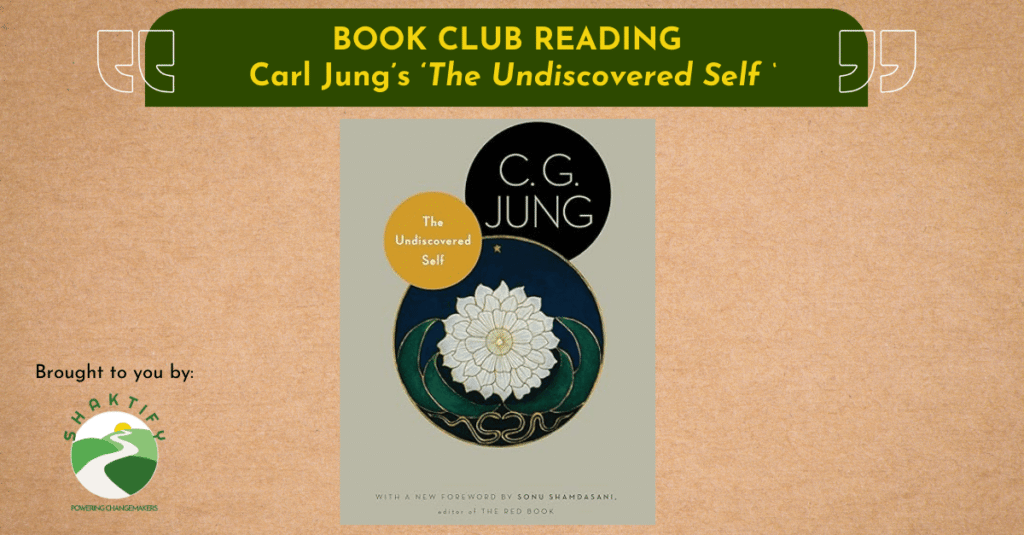
All registrants are required to obtain a copy of Carl Jung’s book and preferably the version depicted in the visual. The advantage of the recommended version is that it has para numbers which we will refer to during our reviews. Registrants can start reading the first two chapters without waiting for the inaugural Zoom meeting.
Costs
There are no costs to participating.
Facilitator

Shakti Saran
Facilitator Profile
Shakti Saran
Facilitator Profile